
TECHNOLOGY AND POWER | BIG INNOVATION CENTRE
How emerging technologies reshape economic power, governance and global competition.
What AI Means for the Heart and Soul of Humanity.
The core issue
Artificial intelligence is often discussed in terms of algorithms, productivity, regulation and economic impact.
Much less attention is paid to how it reshapes meaning, our identity and what societies understand as uniquely human.
AI is not only a technological transformation.
It is also a cultural and philosophical one.
How societies interpret and respond to that shift will shape not only innovation pathways, but the values and narratives through which technological power is exercised.
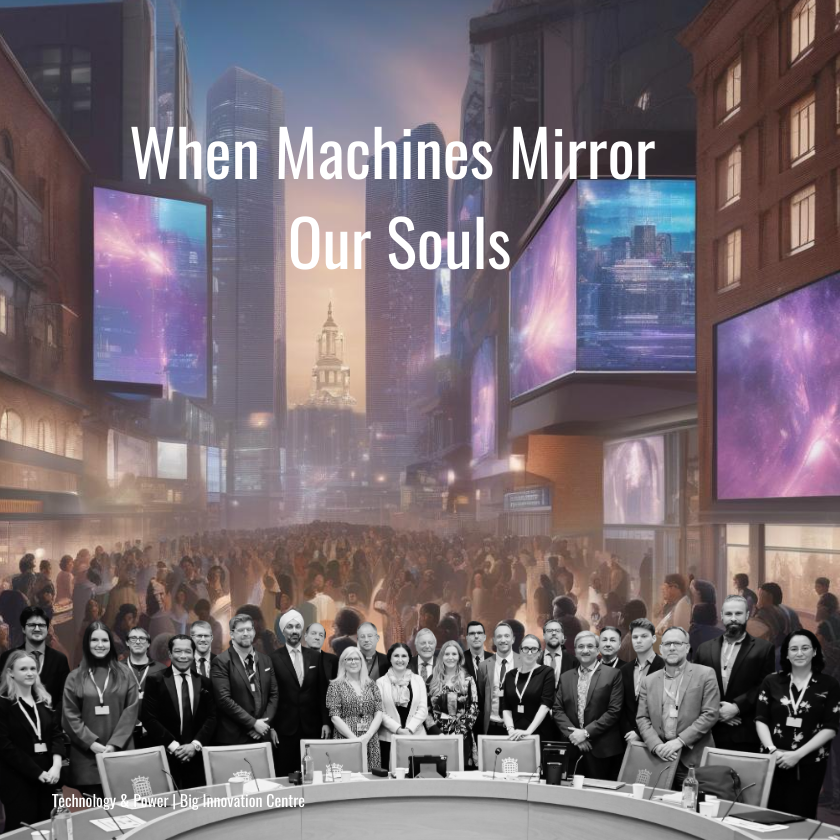
These reflections draw on recent discussions in the UK Parliament, including an All-Party Parliamentary Group on AI roundtable examining the cultural, ethical and spiritual dimensions of artificial intelligence, alongside wider dialogue across research, policy and industry communities.
Power implications
- AI is reshaping cultural understandings of creativity, authorship, and what makes us human.
- Those who shape how technology as AI is understood also shape whether it is trusted, adopted and effectively governed.
- Societies that engage cultural and ethical questions early will shape AI norms globally
Technological power increasingly includes the power to define what it means to be human
Beyond economics and regulation
Debates about artificial intelligence tend to focus on measurable outcomes: algorithms, productivity gains, market transformation, regulatory frameworks and geopolitical competition. These are essential concerns. Yet they represent only part of the transformation now under way.
AI is not simply altering how we work.
It is altering how we understand creativity, authorship, human control and human responsibility, and even social connections.
When technologies begin to generate text, music, films, images and conversations that feel meaningfully human, they do more than increase efficiency. They challenge long-standing assumptions about what is uniquely human and what it means to create, decide and imagine.
This shift is not merely technical.
It is cultural and philosophical.
When machines mirror human capacities
Artificial intelligence increasingly participates in activities once considered uniquely human: writing stories, composing music, producing visual art, assisting reflection and offering forms of conversational support. These developments are not only functional. They reshape, and in some cases blur, long-held beliefs about what it means to be human..
For centuries, cultures and belief systems have helped societies answer fundamental questions:
- What is creativity?
- Where does human control and our responsibility reside?
- What gives human activity meaning and value?
As AI systems begin to generate outputs that resemble human expression, these questions return with renewed urgency. When a neural network produces a poem indistinguishable from a human’s, or when generative tools contribute to artistic production, the boundary between human and machine contribution becomes less clear.
This does not diminish human creativity.
But it does prompt societies to reconsider what creativity means and where its value lies.
AI as a mirror, not just a tool
Artificial intelligence does not only perform tasks.
It reflects human societies back to themselves.
AI systems are trained on human-generated data. They absorb patterns of language, behaviour, culture and bias. In doing so, they become mirrors of collective experience and assumption. When they generate content or support decision-making, they often reproduce the values and perspectives embedded within the data on which they were trained.
This reflective quality makes AI a cultural artefact as much as a technical one. It carries the imprint of the societies that create and deploy it. As such, conversations about AI cannot be purely technical or economic. They must also be cultural and philosophical; – our questions about human existence and meaning.
Questions once considered abstract become practical:
- Is creativity defined by the act of creation or by lived experience?
- Can meaning emerge from systems without consciousness?
- What remains uniquely human in a world of synthetic capability?
These questions influence how societies interpret and accept technological change.
Culture, belief and interpretation
Across societies, cultural and spiritual traditions provide frameworks for understanding purpose, creativity and moral responsibility. The emergence of AI does not replace these frameworks, but it interacts with them.
Different cultures will interpret AI’s rise in different ways.
- Some may see it as an extension of human ingenuity.
- Others may view it as challenging established understandings of what creativity and authorship is, and what human should control or our responsibility.
- Still others may integrate AI into creative and reflective practices, using it as a tool for exploration and expression.
These differences matter.
They shape how technologies are governed, trusted and adopted.
AI does not exist outside culture.
Culture determines what AI becomes.
The frontier of meaning
Public debate often frames artificial intelligence as a question of whether machines can think. Yet the deeper question may be different: how does the presence of increasingly capable machines reshape human self-understanding?
Technological capability alone does not determine societal impact. Meaning does. The narratives societies construct around new technologies influence whether they are embraced, resisted or reshaped.
AI can generate content, optimise systems and support decision-making. But it does not possess lived experience, moral responsibility or a sense of purpose in the human sense. That distinction will continue to matter, even as technological capability advances.
The most significant conversations about AI should therefore take place not only in laboratories or boardrooms, but in cultural institutions, educational settings and communities. These conversations about AI should concern:
- what is our societies value,
- what do we wish to preserve,
- and how to define human contribution in an age of intelligent machines.
These are questions that technical expertise alone cannot resolve.
Meaning as a dimension of technological power
Technological power has traditionally been understood in terms of economic capacity, military capability and industrial strength. Increasingly, it also includes the power to shape meaning.
Those who shape how societies interpret artificial intelligence (whether as threat, tool, partner or extension of human creativity) also shape the conditions under which it is adopted, governed, invested in and ultimately accepted.
In this sense, debates about identity, creativity and meaning are not peripheral to AI policy. They are central to how technological power evolves.
Conclusion: a shared human conversation
Artificial intelligence will continue to transform economies and institutions. It will also reshape cultural narratives about creativity, what makes us human and value. How societies respond to these shifts will influence not only innovation trajectories but also how technological power is exercised and understood.
AI is neither inherently transformative nor inherently destabilising in cultural terms. It becomes what societies make of it; – through the values we embed, the narratives we construct and the boundaries we choose to maintain.
The future of AI will be shaped not only by what machines can do, but by what societies choose to value and preserve.
The most important conversations about artificial intelligence are therefore not only about what machines can do.
They are about what societies choose to value and preserve as technology advances.
In that sense, the future of AI is also a deeply human project.
TECHNOLOGY AND POWER | BIG INNOVATION CENTRE
How emerging technologies reshape economic power, governance and global competition
Professor Birgitte Andersen is Professor of the Economics and Management of Innovation and leads research on the political economy of emerging technologies.