

This is Professor Birgitte Andersen’s point of view on “The Big Digital Debate”, which was part of the Big Innovation Centre’s launch week and hosted at Google in London on Monday 12th September 2011.
The event had introduction from: Matt Brittin, Managing Director, Google UK and was chaired by Benjamin Cohen, Business and Technology Correspondent, Channel 4 News. See event details after the report.
A lot of companies find it very difficult to make money on the Internet, and last night the Big Innovation Centre hosted a thought-provoking event at Google on “how should we pay for the internet?”
The discussion is often geared towards conflicting relationships between producers, providers and the users or consumers. However, I believe that to solve this problem we need to think much bigger. To establish the best supporting policy and business frameworks of value generation on the web, we need to step back and consider the strategic incentives which drove the uptake by businesses to use the Internet and address the problems they encountered.
Also, the problem of making money on the web is often portrayed in relation to the pure intangible firms – such as publishing – supplying digitalized projects and services. However, it applies as much to bricks and mortar firms going online as with physical products. The core of the problem is that industry dynamics on the web has intensified competition and income generation is often extremely difficult.
Let’s consider the problem in relation to five key drivers of changing business models:
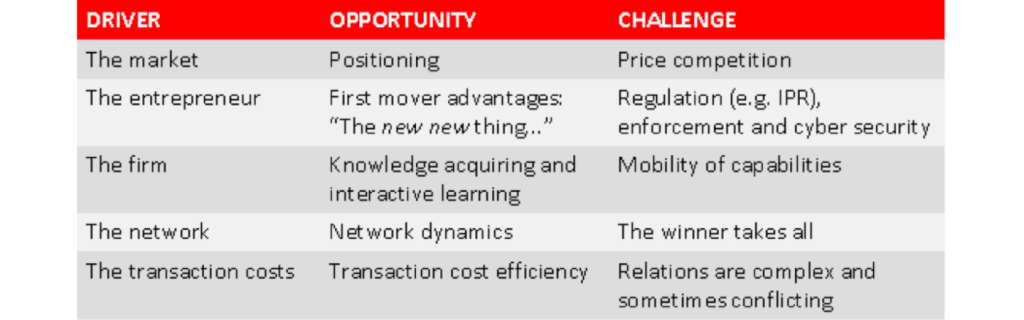
(i) Let’s first look at the market. Many firms moved online believing this could help their market positioning in terms of better reach their consumers and users. Instead they were faced by reckless price competition. Entry barriers came down due to less need to invest in physical assets to reach markets, and bargaining power of buyers went up due to online search engines and price runners comparing and contrasting prices. Also, companies differ less online than in the bricks and mortar world, as they often use the same information technology service solutions making them less unique. All this lead to the squeezing of profits. Especially the burst of the dot.com bubble in 2003, was based upon such dynamics.
(ii) New opportunities were also spotted by the entrepreneurs seeking first mover advantages by developing ‘the new new thing’! The ‘first movers’ digital entrepreneurs created new goods and services which destroyed established markets and created new ones. Even new business models are being invented. Some of the pioneering examples include Amazon.com and their ‘one click system’ and EBay was first to offer customer-to-customer auctions. Other internet service providers connecting people (as digital content file sharing networks) also provides an example. This revealed new challenges to regulation in relation to enforcement, rights, cyber security, data protection, hacking and more. This has for example called for redesigning the IPR system to be fit for the digital age and also here the solution was not strait forward: do we go for stronger enforcement or more flexible IPR regimes?
(iii) The boundary of the firm as a storehouse for resources and capabilities of has also changed. Via information and communication technology, – information, data, technological solutions, and learning processes are increasingly being shared across corporate borders. We can now co-design, co-create and co-learn via the Internet by easier ways of acquiring knowledge and through methods of learning in interaction. Pioneering examples include open source software / pharma communities, open journalism (e.g. the Guardian model), patent pools, and other, which aim is to function as better methodologies to progress our information and knowledge frontier, technology and standard setting in a networked world. The challenge many firms face is that core capabilities is moving from within the firm to become embedded in a network. However, open innovation is increasing in scale and scope as it has become a necessity of firms to acquire knowledge outside their immediate network to sustain their growth.
(iv) The internet offers huge opportunities for the networks as business drivers in general. Basically, the value of particular networks growths with their numbers of members. Examples include social networks like Facebook & Linked-in, mobile networks like Orange, T-mobile, O2, and online gaming as Second Life, but also retail club cards as Boots cards, Nectar cards and more. The dynamics of such networks reveal incredible business opportunities. But the challenge for firms is that this network dynamics is a “winners take all” world in which markets lock users into technological and social infrastructures and switching to another service provider can only be done a very high costs, or not at all . Once networks have become established it is almost impossible for other producers and providers to break in to market, even if there is high entrepreneurship with creative initiatives. This is a standard argument put by software writers wanting to compete with Microsoft office. Furthermore, if the tides are turning for your network and it becomes decreasing in size and value you are in a free fall to destruction. This is what happened to My Space and Yahoo.
(v) Finally, we must not forget how the web has boosted transaction cost efficiency for firms and users. We all know that the internet is a fantastic resource in lowering transaction costs for sharing and coordinating information and also business operations. A global auction house like eBay or any online search engine would never be possible in the physical world. Increased transaction cost efficiency has revolutionised business models and allowed outsourcing as a more efficient alternative to internalising operations. We have moved from value chains to virtual value networks. However, transaction cost relations within networks are complex and sometimes conflicting. Firms traditionally economised on the cost-minimization for each single firm and for every single transaction. However, transactions underpinning network operations are carried out – not in isolation – but in inter-connectivity, and this can lead to conflicts. An example is the online music industry. Even if music producers, and the internet service providers distributing the content to end users, can both benefit from transaction cost efficiency online, then it is harder to agree on who shall pay for the copyright enforcement online; a discussion which became apparent during the Digital Economy Act. Furthermore, it is not uncommon that transaction costs sometimes increase via the Internet. For example, although companies and retail can growth their business from the opportunities provided by the Internet, many report excessive costs imposed on them to constantly develop and manage their web site, to be in tune with their users expectations.
 The core of the argument is that if we want the internet to pay itself, we need to understand how it works and the challenges it brings.
Capitalism works best when there is clear competition, so we must be careful that our solutions and policies does not become protectionist. There is a whole integrated ecosystem of value creators out there. They are embedded in our markets and among our users, producers, entrepreneurs, firms, networks.
This also means that, if we want the Internet to pay for itself, we need to work together and create a holistic solution for long term innovation and growth, – rather than fighting each-other: producers fighting users and visa versa; – established firms fighting the new digital entrepreneurship, and vice versa.
THE BIG DIGITAL DEBATE.
Note : Birgitte Andersen’s point of view on “The Big Digital Debate”, was part of the Big Innovation Centre’s launch week (LINK) and hosted at Google in London on Monday 12th September 2011.
Full event title
 THE BIG DIGITAL DEBATE.
Making the web pay: How can the creative industries succeed online?
Event details
- Date: Monday 12th September 2011
- Evening debate with drinks and networking.
- Venue: Google UK, Central Saint Giles, Saint Giles Passage, London, WC2H 8LA
Opening
- Introduction from: Matt Brittin, Managing Director, Google UK
- Provocation from: Andrew Sissons, Lead Researcher: Markets, place & networks
Chair: Benjamin Cohen, Business and Technology Correspondent, Channel 4 News
Panel
- Professor Birgitte Andersen, Director, Big Innovation Centre
- Alan Freeman, Executive Director, Guardian News and Media
- Simon Bell, Head of Strategic Partnership and Licensing, British Library
- Stian Westlake, Executive Director in Policy and Research, NESTA
- Senior industry representative to be confirmed
Provocation questions for the event:
The digital dilemma
The internet has changed the economy – and our lives – for good. Over the last decade the internet economy has been a key driver of growth and jobs and today Britain leads the world on ecommerce, spending more and exporting more than anyone else. By 2015, the internet economy is forecast to rise to 10% of UK GDP.
But while the internet economy is a powerhouse of growth for the UK, creative industries, from film-makers to newspapers, are under more pressure than ever before to make the web pay for their content.
The result is an explosion of innovation in high-quality content online. Great content is being delivered in new ways, through platforms like Netflix or iTunes, to new fast-growing formats, like Kindle or tablets. But what are the models of innovation that will help high-quality providers grow?
Different players are betting on different models: advertising-driven, or subscription-based. But can either approach succeed?
And consumer demands are changing too – with news becoming quicker, faster, and fewer than 140 characters. And with the bulk of the world’s online videos just a few minutes long – how will what we think of as high-quality content evolve in the future?
This debate addressed such questions as:
- What business models can firms adopt to make money in the digital economy?
- What will high-quality content look like in 15 years: could YouTube ever produce an Oscar winner, or a Twitter feed win the Man Booker Prize?
- If traditional content providers, such as newspapers, are forced to cut back on journalists, what would the implications be for British society?
- What does this mean for policy? Should we be intervening differently?
Provocation publication:
- Fast Forward 2025: The world established as a global open innovation and investment hub – G8 Summit LINK to brochure
- “The Big Digital Dilemma – How should we pay for the web” LINK to report
- LINK to Film of the event